
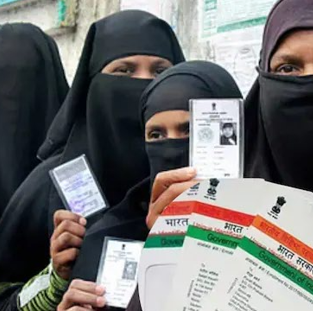
A new mystery has surfaced in Bihar ahead of the upcoming elections, a mystery woven into the fabric of the country’s most crucial identity document: the Aadhaar card. Recent data shows that while the state’s average Aadhaar saturation is about 94%, several Muslim-majority districts are reporting saturation rates well above 100%, raising eyebrows and sparking political and social debate.
In Kishanganj, where Muslims make up 68% of the population, the Aadhaar saturation is an astonishing 126%. The figures are similarly perplexing in other districts: Katihar (44% Muslim) stands at 123%, Araria (43%) at 123%, and Purnia (38%) at 121%. This means that for every 100 residents, there are 120 or more Aadhaar cards in circulation. The question naturally follows: Who do these extra Aadhaar cards belong to, and why were they issued?
The Numbers Don’t Add Up
Aadhaar operates on a one-person, one-identity principle. So, when saturation crosses 100%, it raises serious concerns: Are duplicate Aadhaar cards being generated? Are non-citizens being issued identity documents meant for Indian nationals?
Given the sensitive geographical location of these districts bordering West Bengal, Nepal, and not far from Bangladesh, the theory of cross-border infiltration once again takes center stage. This region, historically known as Seemanchal, has long been under scrutiny for illegal migration.
Some social media reports claim that the surge in Aadhaar numbers is linked to undocumented Bangladeshis, allegedly being issued Aadhaar cards through forged documents and with the help of local political operatives or extremist networks. While concrete evidence for this claim is lacking, the abnormal saturation levels do add fuel to the controversy.
A Brewing Political Storm
The data has not only rattled Bihar but has also stirred concerns in neighboring West Bengal, where Chief Minister Mamata Banerjee has been locked in an ongoing battle with the Centre over Aadhaar deactivation. In 2024, Mamata wrote to PM Modi, accusing the government of targeting SC, ST, and OBC communities by deactivating Aadhaar cards en masse. She even announced an alternative state-level identity card, an idea dismissed by the Centre as illegal.
Now, with the spotlight on Bihar’s Seemanchal region, similar questions are being raised about North Dinajpur and Malda in Bengal, both of which have high Muslim populations and are often mentioned in illegal immigration debates.
Aadhaar, Citizenship, and the Voter List
The Election Commission of India has initiated a Special Intensive Revision (SIR) of electoral rolls in Bihar, with a clear directive: Aadhaar cannot be treated as proof of citizenship. The absence of standard citizenship documents among a section of the population, including birth certificates or domicile records only deepens concerns over the integrity of the electoral rolls. In this context, the government’s push to verify voter identity through multiple layers of documentation, beyond just Aadhaar, emerges as a necessary safeguard to ensure that only eligible Indian citizens participate in the democratic process.
Rather than being a matter of exclusion, this exercise reflects a commitment to electoral integrity and national security, a critical step in preventing the misuse of identification systems in strategically sensitive districts.
Is This a Larger Strategy?
Critics, particularly from the BJP, allege that this is part of a broader game to include illegal immigrants in the voter rolls, aided by inflated Aadhaar registrations. They suggest that the Aadhaar saturation in Muslim-majority districts is not an administrative error, but an electoral maneuver.
These are serious allegations. While firm evidence remains elusive, the fact that certain districts have 26% more Aadhaar cards than people cannot be brushed aside as statistical noise.
Conclusion: A Mystery That Demands Scrutiny
The over-100% Aadhaar saturation in specific regions of Bihar has raised urgent questions about identity, citizenship, and electoral integrity. Is this a case of bureaucratic overlap, systemic loopholes, or something far more deliberate? As India gears up for the next round of elections, the answers could have significant consequences, not just for Bihar, but for the entire nation’s democratic fabric.