
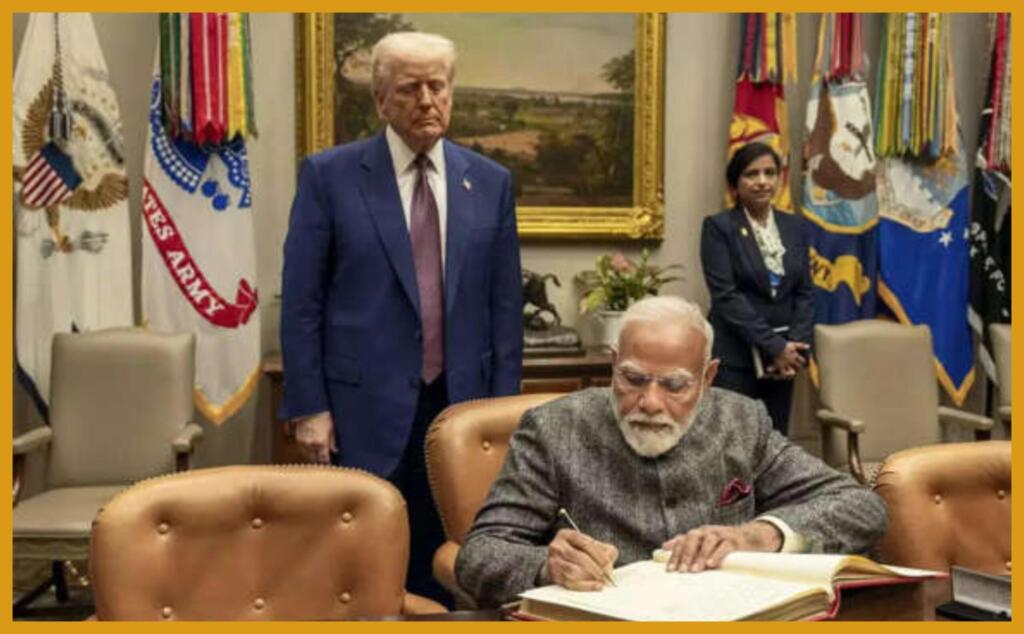
US President Donald Trump has hinted at a significant trade agreement with India, signaling that talks between the two countries may be entering the final stretch. Speaking at an event on Friday, Trump casually dropped the news, saying, “We’ve got some great deals coming. One may be with India. A very big one.”
The comment came just after the U.S. finalized a long-awaited agreement with China, suggesting that India may be next in line for a breakthrough.
Indian Delegation in DC as Talks Intensify
Meanwhile, an Indian delegation led by Rajesh Agarwal, the Commerce Department’s chief trade negotiator, has landed in Washington for what could be the most crucial round of talks yet. Both sides are working against a tight timeline, hoping to wrap up a deal before July 9—the day a suspended U.S. tariff hike on Indian goods is set to kick back in.
Back in April, the U.S. imposed a steep 26% tariff on a range of Indian exports, but agreed to hold off for 90 days to allow space for negotiations. That window is closing fast, and pressure is mounting.
What’s on the Table
The talks have been tough, with both countries looking to protect sensitive sectors while pushing for better access to each other’s markets.
The US wants India to reduce duties on industrial products, cars (especially electric vehicles), wine, petrochemicals, and farm goods like apples, almonds, and genetically modified crops. However, India has held firm on its dairy and agriculture sectors—areas that are politically sensitive and tightly regulated.
India, in turn, is pushing for tariff cuts on goods from labor-heavy sectors such as textiles, apparel, leather, gems and jewellery, plastics, seafood, and select fruits like grapes and bananas.
So far, India has never offered dairy concessions in any of its free trade deals—and it’s not eager to set a precedent now.
Not Just a Quick Fix
Although the immediate goal is to sign a limited deal before July 9 to avoid fresh tariffs, both Trump and Modi governments are thinking bigger. Sources say the talks are part of a broader push to finalize the first phase of a bilateral trade agreement by the fall, with hopes of doubling annual trade to $500 billion by 2030. For context, U.S.-India trade stood at $191 billion in 2024.
Interestingly, despite the tariff threats, India’s exports to the U.S. actually rose this spring—jumping to $17.25 billion in April–May, up from $14.17 billion in the same period last year.
What Officials Are Saying
US Commerce Secretary Howard Lutnick recently said that a deal was “not too far off” and that the two sides had found “a place that really works for both countries.” He added that he’s “very optimistic” about sealing the deal soon.
On the Indian side, Commerce Minister Piyush Goyal has also sounded hopeful. Speaking earlier this month, Goyal said that both Prime Minister Narendra Modi and Donald Trump—who last met in February—had agreed to pursue a “fair and balanced” trade agreement.
“India and the U.S. are not just trading partners—we are close friends and strategic allies,” Goyal said. “This deal is about creating jobs, expanding exports, and building stronger ties between our two nations.”
The Clock Is Ticking
As negotiators scramble to bridge the final gaps, much rides on the outcome. A successful agreement could boost confidence in U.S.-India ties, unlock billions in trade, and give both leaders a win they can tout at home.
But failure to meet the July 9 deadline could trigger a new round of tariffs—raising prices, disrupting supply chains, and putting political pressure back on negotiators.
For now, optimism is high. But in international trade, the details always matter—and the clock is ticking.