
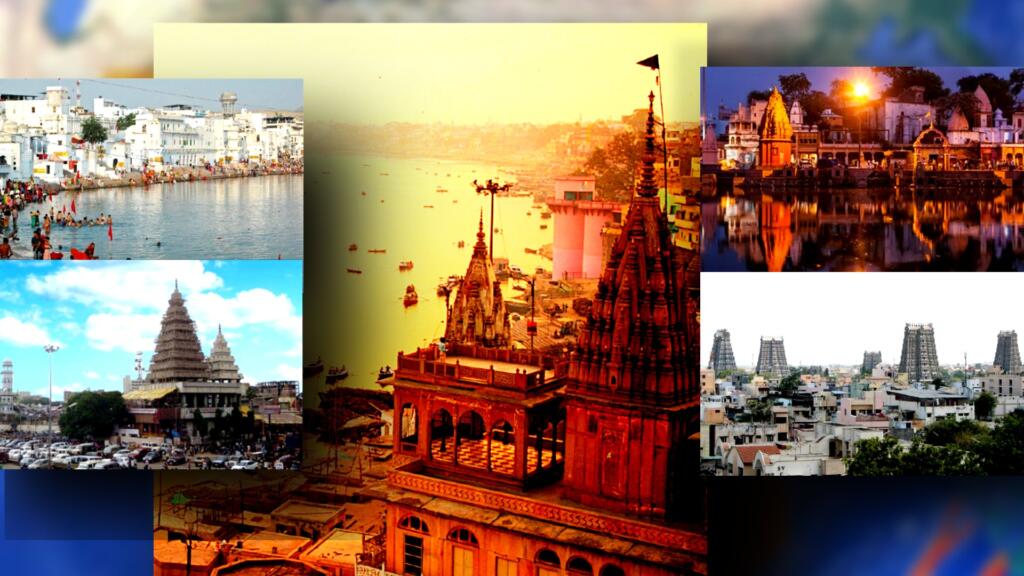
Beneath Tamil Nadu’s soil lies evidence of an advanced civilization- iron forged before the Hittites, a maritime empire trading with Rome, and a script older than Ashoka’s. Genetic links to the Indus Valley and unbroken traditions reveal a suppressed history, waiting to rewrite the world’s past.
The sun rose over the Kaveri delta, its golden light glinting off the ancient stone pillars of temples that had stood for millennia. Beneath the soil, beneath the layers of colonial and post-colonial neglect, lay the remnants of a civilization that had not only thrived but had sustained an unbroken tradition of knowledge, innovation, and cultural resilience.
The Forgotten Cradle of Civilization
While mainstream history celebrated Mesopotamia and Egypt as the birthplaces of human advancement, Tamil Nadu had silently preserved evidence of its own—older, deeper, and far more continuous. Archaeologists had uncovered tools near Chennai dating back half a million years, suggesting that early humans in the region possessed cognitive abilities rivaling—or even predating—those of Homo sapiens elsewhere.
But it was not just antiquity that set Tamil civilization apart—it was the continuity. Unlike the abrupt collapses of Mesopotamia or the Indus Valley, Tamil society had evolved, adapted, and preserved its knowledge systems through the ages.
Metallurgy: The Iron Revolution That History Ignored
The world credited the Hittites (1200 BCE) with pioneering iron smelting, but Tamil Nadu had already perfected it thousands of years earlier. Excavations at Adichanallur (1900 BCE) revealed advanced iron implements, while Kodumanal yielded ultra-high carbon steel—a technology Europe would not master until the Industrial Revolution. The Tamil Sangam texts spoke of ayasa (iron) and velvi (smelting), describing techniques that matched modern metallurgical findings.
Yet, Western historians dismissed these as “local anomalies,” refusing to rewrite their Eurocentric narratives.
The Script That Challenged History
The Brahmi script of Ashoka (3rd century BCE) was long considered India’s oldest. But in Keezhadi, near Madurai, archaeologists uncovered Tamil-Brahmi inscriptions from the 6th century BCE—centuries before Ashoka. Even more startling, the script showed signs of an even older proto-writing system, suggesting literacy in the South predated the North.
The Sangam literature—composed between 300 BCE and 300 CE—was not myth but documented history: detailed accounts of trade, astronomy, medicine, and governance. Yet, colonial historians labeled them “poetry,” stripping them of their historical weight.
The Indus-Tamil Continuity: A Suppressed Link
Genetic studies revealed that the people of Tamil Nadu carried ancestral links to the Indus Valley. Artifacts like steatite beads, terracotta seals, and megalithic burials mirrored those of Harappa. The Dravidian language family, of which Tamil is the oldest surviving member, may have been spoken in the Indus cities.
But why was this connection ignored? Because acknowledging it would mean admitting that India’s oldest urban culture did not vanish—it migrated, evolved, and thrived in the South.
The Maritime Empire the World Forgot
While Rome and Greece dominated Mediterranean trade, Tamil merchants ruled the Indian Ocean. The Periplus of the Erythraean Sea (1st century CE) documented Tamil ships laden with pearls, silks, and spices reaching Egypt and Rome. Excavations in Oman, Thailand, and Indonesia unearthed Tamil inscriptions and pottery.
The Pandya and Chola dynasties later built a naval empire so vast that Chinese records spoke of “Zhu-nian” (Chola) ships dominating Southeast Asia. Yet, modern textbooks reduced them to “regional kingdoms,” erasing their global influence.
The Science Hidden in Temples and Texts
The Silappadikaram, a Sangam epic, contained precise descriptions of celestial movements, matching modern astronomical data. The Tolkāppiyam, a 2,000-year-old grammar text, also encoded principles of physics and phonetics.
Tamil medicine (Siddha) predated Ayurveda, with texts like the Thirumandiram detailing surgical procedures, chemical alchemy, and longevity techniques. European scholars later appropriated many of these ideas, branding them as “new discoveries.”
The Genetic Archive of an Ancient People
DNA studies revealed that Tamils carried Neanderthal and Denisovan genes—unlike North Indian populations—suggesting an unbroken lineage from prehistoric times. Their HLA gene variants were unique, indicating millennia of adaptation.
Yet, when Indian researchers published these findings, Western academia dismissed them as “nationalist pseudoscience.” The same scholars who celebrated European ancestry studies as “groundbreaking” ignored data that challenged their narrative.
The Language That Refused to Die
While Latin, Sanskrit, and Ancient Greek became relics, Tamil survived. Its 2000-year literary tradition is the world’s longest unbroken one. Words like “muthamizh” (the threefold knowledge of literature, music, and drama) encapsulated a holistic worldview lost in modern education.
Even today, Tamil preserves ancient ecological terms—vāli (sustainable farming), kādu (forest management)—concepts the West “rediscovered” only in the 21st century.
The Conspiracy of Silence
Why was this history buried? Because colonial rulers needed to justify their “civilizing mission.” Post-independence, Indian historians, trained in Western frameworks, internalized this bias. The Aryan Invasion Theory, now debunked, was used to paint the South as “primitive.”
But the truth was emerging. Keezhadi’s urban ruins, Porunthal’s 2600-year-old rice grains, Muziris’ lost Roman trade port—each discovery chipped away at the false narrative.
Conclusion: Rewriting History Before It’s Too Late
Tamil Nadu was not just another ancient culture—it was a living knowledge civilization, one that had survived invasions, colonialism, and academic erasure. Its people had invented steel, mastered astronomy, and sailed the world while Europe was still in its Dark Ages.
The question was no longer “Was Tamil civilization advanced?” but “Why was this truth suppressed?”
The answer lay not in archaeology, but in power.
And power, as history shows, fears the past more than the future.