















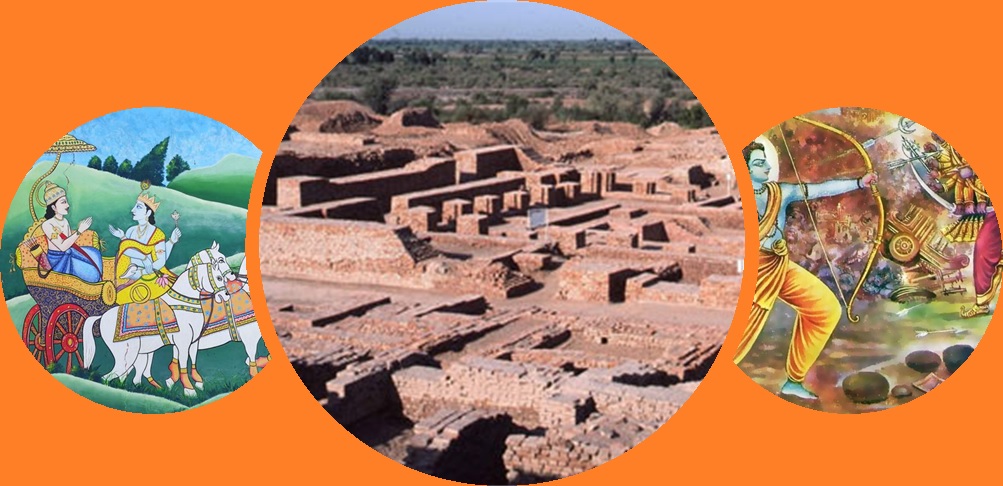
India must reclaim its ancient civilisation using modern, non-invasive archaeological technologies integrated with folklore and local history. Reforming school and college curricula to involve students in GIS, mapping, and research will foster grassroots discovery. Scientific archaeology can reveal India’s lost knowledge, cities, and cultural unity, restoring civilisational pride through evidence-based historical truth.
India’s civilisation, rooted in Hindu philosophy and ethos, stretches back over 10,000 years. Its sacred texts—the Vedas, Upanishads, Puranas, and epics—are repositories of astonishing knowledge covering not only spiritual and philosophical wisdom, but also scientific concepts such as time cycles, cosmology, mathematics, medicine, atomic theory, metaphysics, and ideas eerily close to modern quantum physics and the multiverse. However, very little of this civilisational brilliance finds space in today’s mainstream education or public discourse. The reason is not mere negligence but a consequence of centuries of cultural invasion, destruction, colonisation, and systematic historical erasure.
Foreign invasions razed cities, temples, libraries, and universities. Ancient knowledge was burned, Sanskrit texts destroyed, and entire regions were forced into new languages, religions, and identities. Later, colonial rulers and post-colonial regimes deliberately rewrote Indian history, glorifying foreign rulers while mocking native achievements. India’s school curricula, heavily influenced by Eurocentric perspectives, bred generations of Indians disconnected from their cultural roots—conditioned to view their past as unscientific or mythical.
Yet, India’s history is not only preserved in books and manuscripts—it lies buried in the very soil we walk on. Today, with the advent of advanced non-destructive and non-invasive scientific tools, we have a golden opportunity to unearth and reclaim this buried heritage. We no longer need to rely solely on destructive excavation to understand our past. A powerful synthesis of geospatial technology, engineering tools, AI, folklore, and textual analysis is making archaeology more scientific and accessible than ever.
Globally, archaeology has been transformed by technology. In Egypt and Central America, Ground Penetrating Radar (GPR) has revealed hidden pyramids and temple structures without digging. GPR was crucial in uncovering subterranean tombs near Saqqara’s Step Pyramid. In Britain, magnetic gradiometry has been used to map Roman roads and urban settlements—Silchester being a famous case. Electromagnetic (EM) surveys helped locate ancient ruins in Turkey and Israel, including the famed city of Troy. In Cambodia, satellite imagery and GIS tools mapped the long-lost water infrastructure of Angkor Wat. Metal detectors and magnetometers uncovered vast Anglo-Saxon treasures in England, such as the Staffordshire Hoard. In Italy, AI and 3D reconstruction were used to digitally recreate buildings in Pompeii from fragmented remains.
The lesson is clear: modern archaeology is non-invasive, efficient, and far more insightful when integrated with digital mapping and interdisciplinary methods. India, with its rich oral traditions and surviving folk cultures, is uniquely placed to harness this revolution. Local legends, temple stories, ancient geography, and classical texts contain fragmented memories of historical events and places. These narratives, when cross-referenced with remote sensing, geophysical data, and AI-based pattern recognition, can help pinpoint promising archaeological sites for further study.
India itself has seen some spectacular finds over the past 50 years. At Dholavira in Gujarat, an advanced Harappan city revealed urban planning and water systems unmatched for its time. Rakhigarhi, the largest Indus Valley site in India, yielded artefacts showing extensive craft, trade, and burial practices. In Tamil Nadu, Keezhadi unearthed an urban settlement with literacy and planned infrastructure, linked to the Sangam era. Sinauli, in western Uttar Pradesh, stunned historians with its Bronze Age chariots and weapon-rich burials, hinting at Vedic-era warrior societies. Lothal, also in Gujarat, showed advanced maritime trade through its dockyard and bead-making industry.
Looking ahead, several regions beg for detailed non-invasive surveys. The Sarasvati River basin in Haryana and Rajasthan shows unmistakable satellite evidence of dried riverbeds that match Vedic descriptions. Along its banks lie sites like Kalibangan and Bhirrana—some of the oldest settlements known. Coastal Tamil Nadu and Gujarat are rich in submerged temple sites and possible port towns mentioned in the epics and Sangam literature. The Vindhya mountains and central tribal regions preserve traces of megalithic and prehistoric cultures. Sites associated with the Mahabharata and Ramayana—such as Ayodhya, Kurukshetra, Hastinapur, Dwarka, and Ujjain—warrant geophysical mapping and AI-assisted modelling based on scriptural references.
India’s archaeological work is primarily conducted by the Archaeological Survey of India (ASI), under the Ministry of Culture. Other institutions include the Indian Council of Historical Research (ICHR), Deccan College Postgraduate and Research Institute, NIAS Bengaluru, Physical Research Laboratory (PRL) in Ahmedabad, and various state-level archaeology departments. However, India’s archaeological ecosystem faces major limitations—underfunding, bureaucratic inertia, outdated practices, ideological distortion, and insufficient use of scientific methods. There is a glaring need to revitalise this sector.
A national movement to revive archaeological research must begin with the education system. Schools must teach not only ancient Indian history but also the local history of each region, integrating folklore, community legends, and temple chronicles. Students should be encouraged to visit nearby heritage sites and write projects linking oral tales to historical contexts. Such exposure builds pride, curiosity, and cultural continuity from a young age.
At the college level, history and archaeology departments should be funded to collaborate with engineering and computer science departments. Students can jointly develop and operate low-cost tools like metal detectors, magnetic gradiometers, and drones for site surveying. These technologies can be locally built and used for non-invasive surveys of ancient mounds, ruins, or temple complexes. Colleges should be incentivised to submit their findings to ASI or ICHR along with excavation proposals, creating a structured pipeline for grassroots archaeological discovery.
In addition to hands-on training, students must learn GIS tools, satellite mapping, and AI-based image processing. Curriculum must include methodologies for integrating textual and oral traditions with physical mapping. A tale passed down for generations about a submerged temple or a hidden fort must not be dismissed as folklore—it may hold keys to historical truth.
Beyond academic research, there must be a system for documentation, publication, and dissemination. Findings must be rigorously recorded, photographed, and preserved digitally. Colleges and institutions must be encouraged to publish papers, monographs, and reports in national and international forums. Annual seminars, field conferences, and workshops should be conducted at the district, state, and national levels.
Further, a formal methodology of awards and recognition is needed. Promising student researchers, institutions, or independent contributors must be publicly honoured. Their work should be evaluated by panels of historians, archaeologists, geophysicists, and AI specialists. Findings with high potential should be fast-tracked for excavation, conservation, or public exhibition through ASI or state archaeology departments.
What do we expect to uncover through this revitalised archaeological thrust? Not just buildings or artefacts, but a deeper understanding of:
India’s pre-Vedic and Vedic societies—how they lived, governed, traded, and worshipped.
Lost cities, ancient ports, trade routes, and temples mentioned in epics.
Forgotten scientific achievements in metallurgy, town planning, water management.
Cultural links between different parts of India that point to a unified civilisational ethos.
Real-world corroboration of Ramayana and Mahabharata geography.
Evolution of script, language, and religious iconography.
Long-standing regional traditions and their deep-time continuities.
India has the intellectual talent, cultural depth, and technological capacity to lead a world-class archaeological renaissance. What it needs is political will, academic openness, and grassroots participation. Reclaiming our past is not a regressive act—it is a forward-looking effort to root India’s global leadership in civilisational confidence.
In an age where historical truth is often twisted to serve ideology or politics, we must ground our narratives in science, soil, and self-respect. The tools are in our hands. The stories are under our feet. The question is—will we listen to the earth beneath us?
It is time to let the land speak, and let the truth rise.