
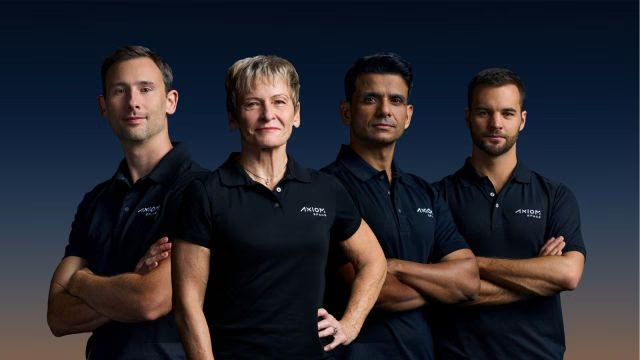
Group Captain Shubhanshu Shukla, India’s second astronaut to reach space after a 41-year gap, sent a heartfelt and culturally rooted message from the International Space Station (ISS) as part of the ongoing Axiom Mission 4 (Ax-4). His candid words “I’ve been sleeping a lot” offered a rare glimpse into the human side of spaceflight while reaffirming India’s growing role in global space exploration.
“The body takes time to adjust to microgravity. I feel like a baby; every moment here is a fresh discovery,” said Capt Shukla in his first video message from orbit.
The Ax-4 mission, launched on June 25 from NASA’s Kennedy Space Center in Florida, docked with the ISS the following day. It is one of the world’s first all-private missions to the space station, operated by Axiom Space in partnership with SpaceX.
Capt Shukla serves as mission pilot alongside a four-member multinational crew that includes veteran NASA astronaut Peggy Whitson (USA) as commander, Sławosz Uznański (Poland), and Tibor Kapu (Hungary).
“I’m here with one veteran astronaut and three rookies, and I’m one of them,” he said. “We’re learning together, supporting each other, and contributing as a team.”
Cultural Symbolism in Orbit
Floating beside him aboard the ISS is a plush toy swan named Joy, chosen as the mission’s zero-gravity indicator. More than a visual cue, the swan carries profound cultural symbolism.
“The swan is the vehicle of Goddess Saraswati, the embodiment of wisdom and learning in our culture. It is said to have the rare ability to separate milk from water; a powerful metaphor for clarity, discernment, and grace under pressure,” Shukla explained.
He added that while the swan stands for wisdom in Indian tradition, it also symbolizes resilience in Poland and grace in Hungary, reinforcing the mission’s spirit of international unity.
Scientific Contributions
Over the next two weeks, the Ax-4 crew will conduct more than 60 scientific experiments, seven of which have been developed by Indian researchers. These include studies on:
Muscle regeneration (myogenesis) in microgravity
Seed germination (moong and methi) in space
Tardigrade survival biology
Microalgae and cyanobacteria as sustainable bioresources
Neurocognitive changes in microgravity
These experiments are expected to generate critical data for India’s upcoming Gaganyaan mission, which aims to send Indian astronauts to space aboard an indigenous spacecraft by 2027.
India’s Culture in the Cosmos
As part of his outreach and cultural engagement goals, Capt Shukla is also expected to:
Perform yoga in microgravity
Share traditional Indian food (such as rajma-chawal and halwa) with the crew
Interact with Indian students via amateur radio sessions
His first words post-launch “Jai Hind, Jai Bharat” have already gone viral, drawing comparisons with Rakesh Sharma’s iconic 1984 message.
“To the children of India: keep dreaming. Stay curious. I am just one of you, who looked up and followed a dream. You can too,” he said in his message from space.
A Defining Moment for Indian Spaceflight
India’s participation in Axiom Mission 4 marks a strategic and symbolic leap from government-led missions to global commercial collaborations. The mission also demonstrates India’s readiness to engage with the next phase of space exploration through science, diplomacy, and culture.
Shukla’s deeply personal updates from sleep cycles to swan symbolism are offering the world a rare look at space through an Indian lens.
“I’ve been sleeping a lot,” he admitted. “But I’m healthy, happy, and incredibly honored to be here.”
As India watches one of its own float among the stars once again, it’s not just science that has taken flight but also the dreams of a billion.