
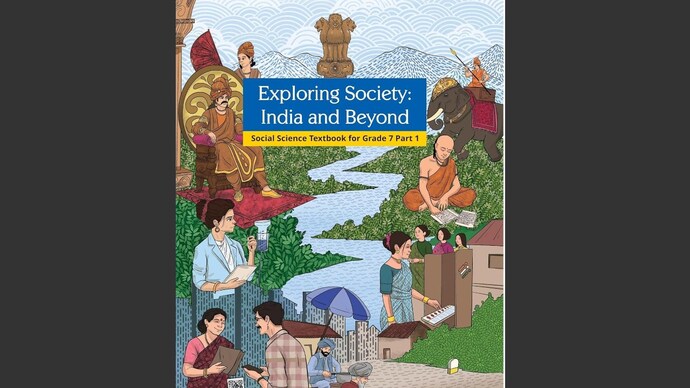
The National Council of Educational Research and Training (NCERT) has made major changes to the Class 7 Social Science syllabus for the academic year 2025–26, dropping chapters on the Delhi Sultanate and Mughal Empire. Instead, the new syllabus focuses on ancient Indian dynasties, pilgrimage practices, and India’s rich cultural heritage.
Students will now study from a newly consolidated textbook titled Exploring Society – India and Beyond (Part 1), replacing the earlier system of separate books for History, Geography, and Civics. NCERT officials have indicated that a second part of the textbook will be published later this year to complete the syllabus.
Ancient Dynasties in Focus
The history portion of the new book ends with the Gupta dynasty, covering the period from the 3rd to 6th centuries AD. It highlights major ancient empires like the Mauryas, the reign of Ashoka, and various southern and central Indian dynasties such as the Shungas, Satavahanas, Chedis, Cholas, Pandyas, and Cheras. This represents a clear departure from the previous textbooks, which included extensive sections on medieval rulers, including the Sultans of Delhi and the Mughal emperors.
No Coverage of Delhi Sultanate or Mughals
Unlike earlier syllabus revisions during the COVID-19 pandemic — which merely trimmed certain sections — this update completely omits chapters on medieval Islamic tyrants. It remains unclear if these topics will be reintroduced in Part 2 of the textbook.
Introduction of Pilgrimage Sites and Mahakumbh
A new chapter – How the Land Becomes Sacred – introduces students to various religious pilgrimage sites across Hinduism, Buddhism, Islam, Christianity, Judaism, Sikhism, and Zoroastrianism. The Mahakumbh is given special attention, with a mention of its massive turnout of 660 million pilgrims.
Highlighting India’s Intellectual Legacy
The new curriculum gives more importance to India’s ancient knowledge systems, with thinkers such as Kautilya, Panini, and Aryabhata. Work in areas such as governance, linguistics, and astronomy is elaborated upon. Sanskrit words are used with correct diacritical marks to facilitate proper pronunciation.
The textbook also discusses the development of India’s social structures, how the varna-jati system progressively hardened into a rigid hierarchy during colonial times, leading to long-term social inequalities.
Officials confirmed that this release is just half of the new curriculum, even though they refused to confirm if Delhi Sultanate and Mughal eras will be included in the second part.